







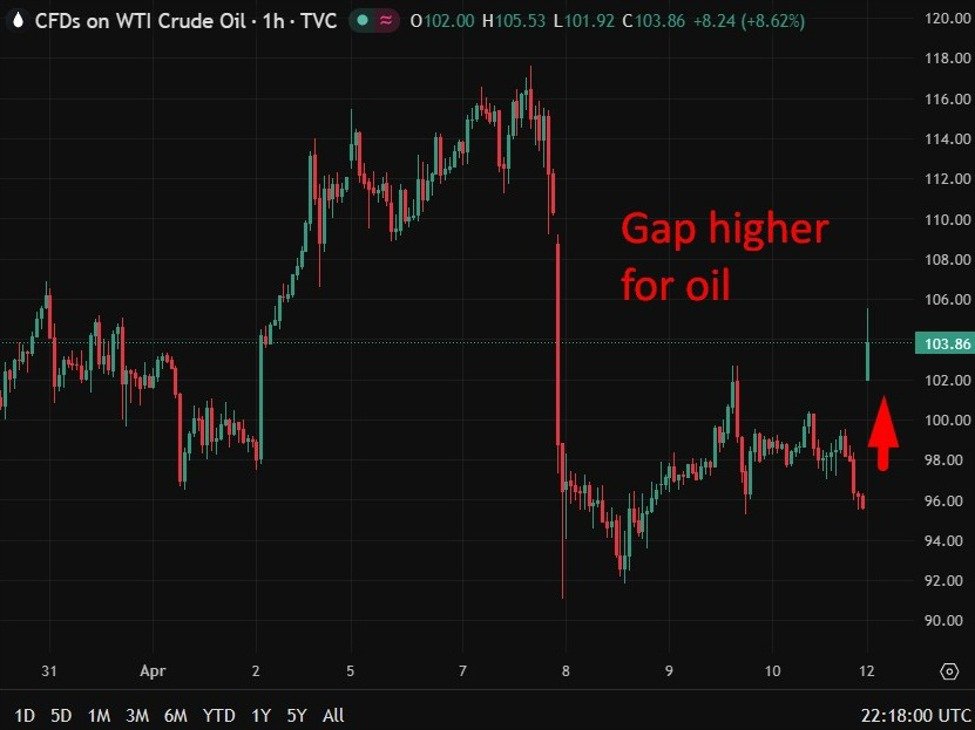
WSJ (gated) report that Trump is weighing limited strikes alongside a Hormuz blockade after talks failed, keeping diplomacy alive but shifting toward pressure tactics. The policy path remains uncertain, with escalation and restraint both carrying significant risks.
Summary:
- Trump weighing limited strikes alongside Hormuz blockade after talks collapse
- Full-scale war seen as less likely but still on the table
- Diplomatic channel remains open despite hardening US red lines
- Blockade viewed as “least bad” option but carries escalation risk
- Oil market caught between supply risk and policy uncertainty
The White House is actively weighing its next move on Iran following the collapse of high-level talks in Pakistan, with President Donald Trump considering a range of options that span renewed military action and continued economic pressure. According to officials familiar with internal discussions, one of the leading options is a return to limited, targeted strikes on Iranian infrastructure, potentially alongside the recently announced naval blockade in the Strait of Hormuz.
A broader, full-scale bombing campaign remains under consideration but is viewed as less likely given the risks of deeper regional destabilisation and the administration’s sensitivity to prolonged military engagement. At the same time, Trump is said to be exploring a more flexible blockade approach, potentially transitioning toward a longer-term multinational escort framework involving US allies.
Despite the breakdown in talks, the door to diplomacy has not been fully closed. Both US and Iranian officials have signalled that negotiations could resume, though the gap between the two sides remains substantial. Washington’s demands include full reopening of the Strait of Hormuz without tolls, the dismantling of Iran’s nuclear enrichment programme, the surrender of enriched uranium stockpiles, and an end to Tehran’s support for regional proxy groups. Iran’s refusal to concede on its nuclear programme was a key factor behind the talks collapsing.
The administration now faces a narrow path. Escalating militarily risks further entrenching conflict and draining resources, while stepping back could allow Iran to retain strategic leverage over energy flows and its nuclear ambitions. The blockade itself is seen by some officials as the most viable pressure tool, targeting Iran’s oil export revenues while attempting to reassure global markets that the Strait of Hormuz will remain operational.
However, the approach is not without danger. US naval assets operating in the confined waters of the Gulf face heightened exposure to missile and drone attacks, while Iran has historically shown resilience to economic pressure. The result is a highly uncertain policy path, with markets increasingly focused on whether the next move is calibrated escalation, or something more severe.
–
The combination of a blockade and potential limited strikes keeps oil structurally bid, but without an immediate supply shock unless escalation spills into Hormuz transit. Volatility remains elevated, with crude skewed higher on headlines. FX sees USD supported on risk and energy dynamics, EUR pressured via energy exposure, while oil-linked currencies gain. Rates face renewed inflation uncertainty, complicating central bank outlooks. Equities remain fragile and headline-driven, with energy outperforming and broader risk assets capped.


