


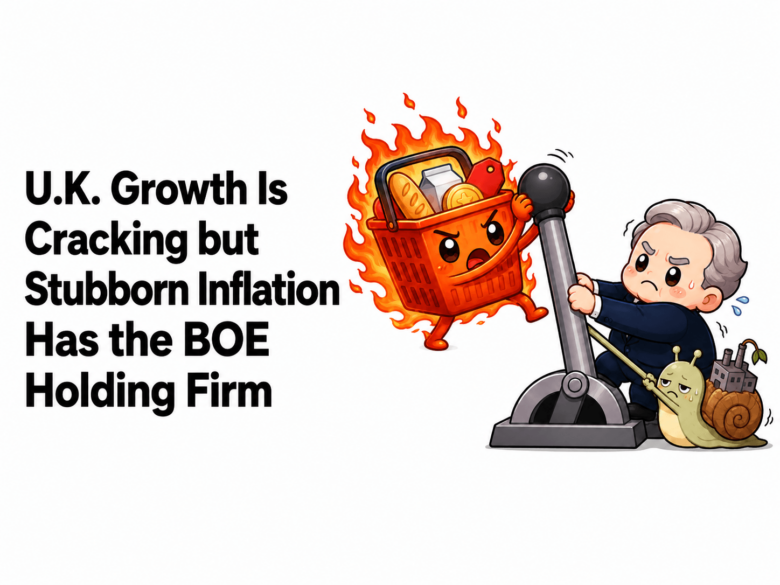
This week, the U.K. dropped a double whammy of economic data, with fresh labour market figures printing on Tuesday and April inflation numbers following on Wednesday.
Four Bank of England policymakers, including Governor Andrew Bailey, then sat before parliament to explain what it all means.
The short version is that inflation is cooling on the surface, the jobs market is showing real cracks, and the central bank is more divided than ever about what comes next.
Let’s slow it down and follow the chain:
The Labour Market Paradox: Soft on the Surface, Sticky Underneath
The U.K. labor market is looking a little softer around the edges, with the unemployment rate rising to 5.0% from 4.5% a year ago and job vacancies falling to 705,000, below pre-pandemic levels.
Wage growth still looked decent on paper, with pay up 4.1% including bonuses and 3.4% without them. But after inflation, the picture was a lot less exciting, as real pay growth excluding bonuses barely rose at 0.3%.
On the surface, that looks like a cooling labour market, and in many ways it is. Payrolled employment is falling, vacancies are at a five-year low, and workers’ bargaining power has weakened materially compared to four years ago.
The head-scratcher, though, is that wage growth in cash terms is still running above what the BOE considers sustainable.
The BOE has said a pay growth rate of roughly 3.25% is what it considers consistent with on-target inflation, and at 3.4% to 4.1%, that threshold has not been comfortably crossed.
When wage growth stays elevated, that extra cash burns holes in workers’ pockets. They spend it, and businesses turn around and raise prices to cover their higher payrolls. That can keep inflation sticky through late 2026 and even bleed into 2027 wage talks, right when policymakers are hoping the problem is finally under control.
Inflation: Don’t Let the Headline Number Fool You
The U.K.’s CPI report looked like real progress at first glance. Headline inflation slowed from 3.3% to 2.8% in April, while core CPI and services inflation eased enough to put inflation a lot closer to the BOE’s 2% target.
The problem is that a good chunk of the improvement is a statistical mirage. A big part of the slowdown came from base effects, since April 2025 inflation was unusually high. That means the comparison made this year’s inflation look better than it might really be. Analysts widely expect the annual rate to bounce again in May once that favorable comparison rolls off.
The bigger issue is services inflation. Remember, the U.K. is a service-driven economy, which means that it thrives on banking, hospitality, shops, and entertainment. Services rely heavily on human labor, which means they are directly tied to those sticky wages we just talked about. Second-half inflation trends are going to be key to where wages go next.
So, as long as pay gains stay elevated, services inflation has a floor under it, and as long as that floor holds, the BOE can’t really declare victory just because the headline number cooled.
The Restrictive Reality: No Consumption Boom in Sight
So, how does this messy data translate to monetary policy? The data make it crystal clear that the U.K. economy is simply too weak to ignite any kind of wild consumption boom.
This locks in a “higher-for-longer” rate path, and BOE officials spilled the beans confirming it this week.
Swati Dhingra flatly noted the economy looks “too weak for any consumption boom,” adding that current “restrictiveness” lets them avoid more hikes. Why? Because the broader financial markets are doing the heavy lifting. Banks are pulling back on lending, and corporate borrowing costs are creeping up on their own.
Sarah Breeden pointed out that this “tightening in financial conditions” is happening from an “already restrictive place.” Governor Andrew Bailey agreed, noting this market tightening buys them “some time to assess whether to raise rates.” They can sit on their hands because commercial markets are already doing the dirty work of slowing things down.
But don’t count on rapid rate cuts, folks. Make no mistake, the high-rate narrative is locked in. Breeden warned that if global tensions flare into a “prolonged Middle East conflict with pronounced 2nd round effects,” the BOE will move “quickly and possibly forcefully.” The screw is turned tight, but they’ll crank it further if geopolitical shocks spark fresh inflation.
The Asset Domino Effect: Gilts First, Then Sterling
When you take a cooling economy, sticky services inflation, and interest rates stuck on a high shelf, how do financial assets react?
Let’s follow the money.
UK Government Bonds (Gilts)
First up are U.K. government bonds, better known as Gilts.
Fixed income traders know the basic rule: bond prices and yields move like a seesaw. When yields rise, prices fall.
This week’s sticky data suggests the U.K. may be stuck with restrictive policy for longer, so investors are demanding higher yields to hold Gilts. That has pushed Gilt yields higher and knocked down the prices of existing U.K. bonds.
The British Pound (GBP)
Now, let’s talk about Sterling. Currencies love interest rate differentials. Global capital tends to go where it can earn the highest return without taking on too much extra risk.
Because the U.K.’s sticky wage and services data could keep policy tighter for longer while other major economies lean toward rate cuts, the pound has a solid fundamental floor. That keeps the U.K.’s yield advantage alive and gives Sterling room to stay supported against peers like the euro and U.S. dollar.
Promoted: When U.K. data is sending mixed signals and the BOE still wary of inflation, Sterling traders need more than a hot take.
Maven Trading provides simulated funding challenges starting as low as $15, allowing you to trade major pairs with professional sized capital. No time limits mean you can wait for cleaner setups around BOE commentary, wage data, CPI updates, and GBP driven moves without the pressure of a ticking clock.
Learn More About Maven Trading Today!
Disclosure: We may earn a commission from our partners if you sign up through our links, at no extra cost to you.
Quick Takeaways
- CPI fell to 2.8% in April, with core at 2.5% and services down to 3.2%, though the improvement is partly a base effect that is likely to reverse in May.
- Wage growth at 3.4% to 4.1% in cash terms remains above the BOE’s sustainable threshold of roughly 3.25%, keeping the higher-for-longer narrative firmly intact.
- The MPC is split, with Breeden and Dhingra leaning toward cuts, Mann leaning hawkish, and Bailey holding the centre with a clear patience bias.
- Higher UK yields mean lower prices for existing gilt holders, and the yield curve is worth watching as a leading indicator of where rate expectations are heading.
- Sterling’s yield advantage provides structural GBP support, but geopolitical energy shocks remain the wildcard that could reshape the entire picture quickly.
What to Watch Next
The next BOE decision and the May CPI release are the immediate triggers. With base effects reversing, services inflation and wage data in the coming months will be far more telling than April’s headline drop.
When the next wage print arrives, the number to benchmark it against is 3.25%. That is the level the BOE has signaled it needs to see wages settle toward before further cuts become a cleaner call, and both GBP/USD and EUR/GBP will be listening closely for it.
This article digs into the BOE’s policy dilemma as sticky wages and services inflation complicate the path to rate cuts. Premium members can read our lesson:
Reading this helps you understand how the BOE sets monetary policy, the key economic indicators that move the pound, and how to trade GBP pairs around U.K. data releases.
And if you’re not a Premium subscriber yet, now’s a good time to sign up.
With Babypips Premium, you get full access to School of Pipsology lessons that help you understand not just what the pound is doing, but the Bank of England dynamics and U.K. economic data driving the move.
