







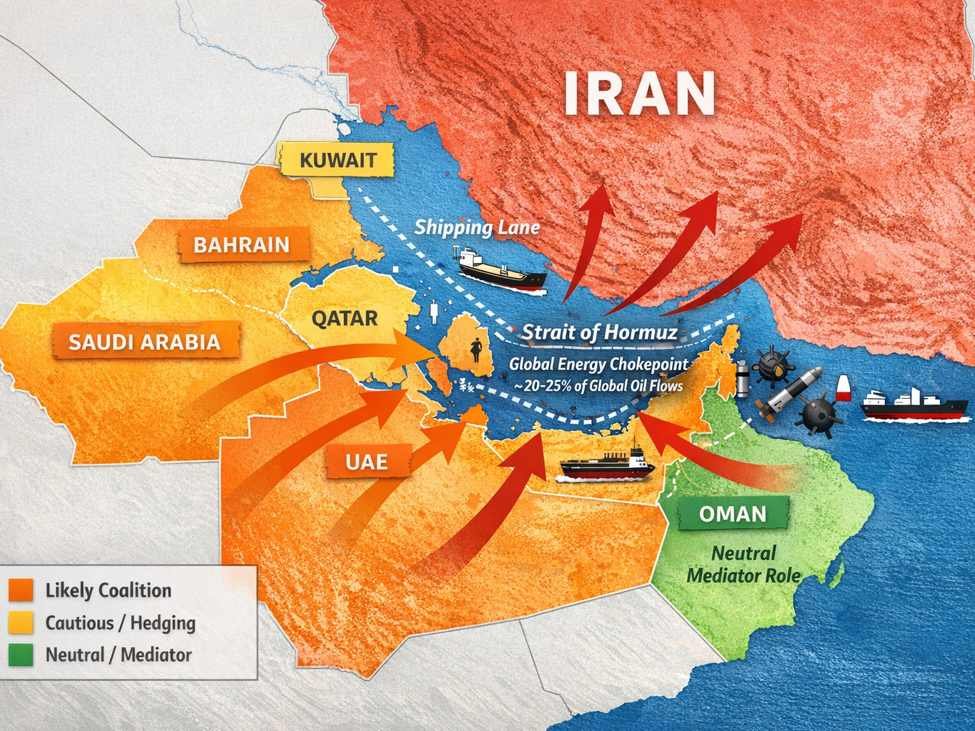
The UAE is leading the Gulf’s hawkish turn on Iran, pushing for a coalition to reopen the Strait of Hormuz and signalling willingness to play a direct military role. Saudi Arabia and Bahrain appear closer to that camp than Qatar, Oman and Kuwait, but a true Gulf coalition remains politically uneven. If one forms, it would most likely center on U.S.-led maritime security, air defence, escorts, mine-clearing and logistics rather than a full-scale ground war. The big challenge is that Iran can still impose heavy disruption through asymmetric means even without controlling the battlefield conventionally
Summary:
- The UAE has moved furthest toward direct military participation, saying it could join a U.S.-led effort to secure or reopen the Strait of Hormuz and, according to recent reporting, is now lobbying for a broader coalition and even UN cover for action.
- Saudi Arabia and Bahrain appear more aligned with the harder line than Qatar, Oman and Kuwait, but the Gulf is not fully united on direct warfighting. Reuters reports the UAE, Saudi Arabia and Bahrain are prepared to absorb more escalation, while Qatar, Oman and Kuwait prefer a quicker end to the war.
- Militarily, a Gulf coalition would not try to “conquer Iran.” Its more realistic mission set would be air and missile defence, maritime escort, mine-clearing, intelligence support, logistics, and possibly limited strikes or island-seizure support near Hormuz.
- The Gulf states’ edge is in advanced Western airpower and air defence, but Iran’s advantage remains asymmetric warfare: drones, missiles, mines, fast boats and the ability to keep shipping under threat even after suffering heavy damage.
- The key uncertainty is political, not just military: whether Washington wants a prolonged Hormuz operation, whether enough partners sign on, and whether Gulf capitals are willing to absorb more Iranian retaliation against cities, ports and energy infrastructure
The emerging story in the Gulf is no longer just whether the United States winds down the war with Iran, but whether a broader Arab-backed security architecture begins to form around reopening the Strait of Hormuz and containing Iran’s missile, drone and maritime threat. The UAE has become the clearest test case. Reuters reported in mid-March that Abu Dhabi could join a U.S.-led effort to secure shipping in Hormuz, while later reporting from the Wall Street Journal said the UAE is now actively preparing to help force the strait open and is pushing for a coalition that could include Western and Asian powers.
That marks a major strategic shift. For years, the Gulf monarchies tried to avoid being seen as direct combatants against Iran. But repeated Iranian strikes on Gulf territory, plus the economic damage from Hormuz disruption, appear to be changing that calculus. Reuters says Gulf states are privately telling Washington that a ceasefire alone is not enough and that any endgame must permanently curb Iran’s ability to threaten shipping, energy flows and civilian infrastructure with missiles, drones and proxies.
The Gulf, however, is not moving in lockstep. Reuters reports that the UAE, Saudi Arabia and Bahrain are the states most willing to absorb escalation and push for a tougher postwar settlement, while Qatar, Oman and Kuwait are more focused on bringing the war to an end and limiting the economic fallout. That split matters because any coalition is more plausible if it begins with a core of willing states rather than full GCC unanimity. Bahrain is especially relevant politically because it hosts the U.S. Navy’s Fifth Fleet, while Saudi Arabia matters because of its scale, geography and airpower.
In military terms, a Gulf coalition with the U.S. would probably not look like a classic invasion force. It would more likely be a layered maritime-air campaign. The United States would provide the backbone: carrier aviation, ISR, electronic warfare, tanker support, missile defence enablers, command-and-control, and the naval muscle to escort shipping and suppress Iranian threats. Gulf partners would add air bases, proximity, logistics hubs, Patriot and THAAD-type defences, local air forces, naval patrol assets, and potentially mine-clearing or escort roles. CSIS notes that Gulf states are already deeply engaged in intercepting Iranian missiles and drones and, alongside the U.S., rely on Patriot systems for ballistic and cruise missile defence while using other aircraft and short-range systems against drones.
The UAE is especially notable because it combines willingness with useful geography and capable forces. Reporting indicates Abu Dhabi is examining roles such as mine-clearing and support for reopening the strait, and analysts cited by the Wall Street Journal say its bases, deep-water port at Jebel Ali, and location near Hormuz could make it a valuable staging platform. Saudi Arabia brings weightier scale, deeper resources and an advanced air arm, while Bahrain offers strategic basing. Kuwait is more exposed geographically and useful logistically, but politically more cautious. Qatar has important U.S. basing value but has tended to preserve channels and flexibility. Oman remains indispensable diplomatically and geographically because of its relationship to the strait, yet is more naturally positioned as a mediator than a front-line combatant.
Still, the main point is that even a strong coalition would not make Hormuz an easy problem. Analysts keep stressing that Iran does not need naval dominance to keep the waterway dangerous. Mines, drones, anti-ship missiles, small boats and persistent harassment can be enough to threaten commercial traffic and keep insurers, shippers and energy markets on edge. CSIS says the key question is how much residual missile and drone capacity Iran still retains and whether a U.S. operation to open the strait can actually neutralise it enough to restore normal shipping.
What happens next depends on politics as much as tactics. One possibility is a limited coalition focused on escorts, mine-clearance and deterrence, especially if the U.S. wants allies to carry more of the burden while avoiding a prolonged American occupation-style commitment. Another is a looser coalition in which Gulf states provide basing, intelligence and defensive cover rather than overt strike participation. The most escalatory path would involve direct Gulf combat roles or attempts to seize or secure key islands and approaches near Hormuz. For now, the UAE appears to be pushing hardest toward action, but the chances of a full, openly declared Gulf war coalition still depend on whether Washington commits, whether partners believe the mission is achievable, and whether they are prepared for more Iranian retaliation in return.


