



Talks between Washington and Ottawa collapsed hours after Trump called a deal “pretty much” done. Here’s what the new 50% tariffs actually cover, why the loonie’s reaction is more restrained than the headline suggests, and what it teaches traders about how currency pairs really move.
Trade talks between the United States and Canada collapsed Friday night. Hours earlier, President Trump told reporters a deal was “pretty much” done. By Saturday at 12:01 a.m. Eastern, 50% tariffs hit roughly $20 billion of Canadian exports instead. Canada’s response: match it, dollar for dollar, starting September 8.
Here’s what happened, why it happened, and why USD/CAD isn’t moving the way the headlines suggest it should.
What Did the US Just Do to Canada?
The United States imposed a 50% tariff (a tax on imported goods, paid by the company bringing them in, not by the exporting country) on close to $20 billion worth of Canadian products, or roughly C$28 billion by Canada’s count. That’s a specific slice of trade, not the whole relationship. Affected goods span dairy, wine, cement, furniture, wood products, ceramics, clothing, and electronics, the largest single category at over $4 billion.
Prime Minister Mark Carney called it “a miscalculation.” He was blunter in a press conference: “You’re at war when you get attacked. We got attacked.” Canada’s countermeasures start September 8, hitting US steel, dairy, appliances, agricultural equipment, pulp, paper, and electronics. Match it dollar for dollar, nothing more.
This didn’t come out of nowhere. The US and Canada have been circling this outcome since February 2025, when Washington first imposed tariffs on Canadian and Mexican goods. What’s new is the collapse of one specific negotiation both sides seemed close to closing, just days earlier.
Promoted: Trading a Trade War Requires Real Capital, Not Just a Strong Thesis
Reading USD/CAD’s muted reaction to a 50% tariff shock is one thing. Having the capital to actually act on that kind of nuanced, cross-currency read is another. FundedNext empowers disciplined traders by providing simulated trading accounts up to $200K, with no artificial time limits on challenges. You even earn a unique 15% profit share during your evaluation. Once funded, keep up to a 95% profit split with guaranteed 24-hour payouts, and trade CFDs or Futures your way, even during high-volatility news events like this one.
Join over 400K traders who have received $300M+ in payouts.
Learn More About FundedNext!
Disclosure: We may earn a commission from our partners if you sign up through our links, at no extra cost to you.
Why Did the Talks Fall Apart?
The two governments tell different stories. That’s normal in a breakdown like this.
Carney says Washington introduced new terms late in the process: less tariff relief on Canadian-made vehicles, limits on Canada’s ability to strike deals with other countries, weaker protections for language and culture. He called it a sovereignty issue. “We were not prepared to compromise Canada’s sovereignty or undermine our key industries.”
US Trade Representative Jamieson Greer sees it differently. His office says Washington had already agreed to reduce tariffs on steel, aluminum, autos, and lumber, plus aerospace coordination and formal talks to renew the broader North American trade deal. In his account, Canada walked back terms it had already accepted.
One detail worth knowing: the US reportedly used Section 338 of a 1930s trade law to justify these tariffs. It’s never been invoked before. That matters because the Supreme Court struck down a different set of Trump tariffs in February, ruling he’d overstepped his authority under emergency powers law. Washington is testing new legal ground.
Underneath both accounts sits a leverage problem. Canada is the second-largest US trading partner, but the US matters far more to Canada’s economy than Canada matters to America’s. When one side has more to lose, that shapes what it’s willing to walk away from, the same logic behind how fiscal policy moves currencies: less at stake means more room to bluff.
What Does This Mean for the Canadian Dollar and Markets?
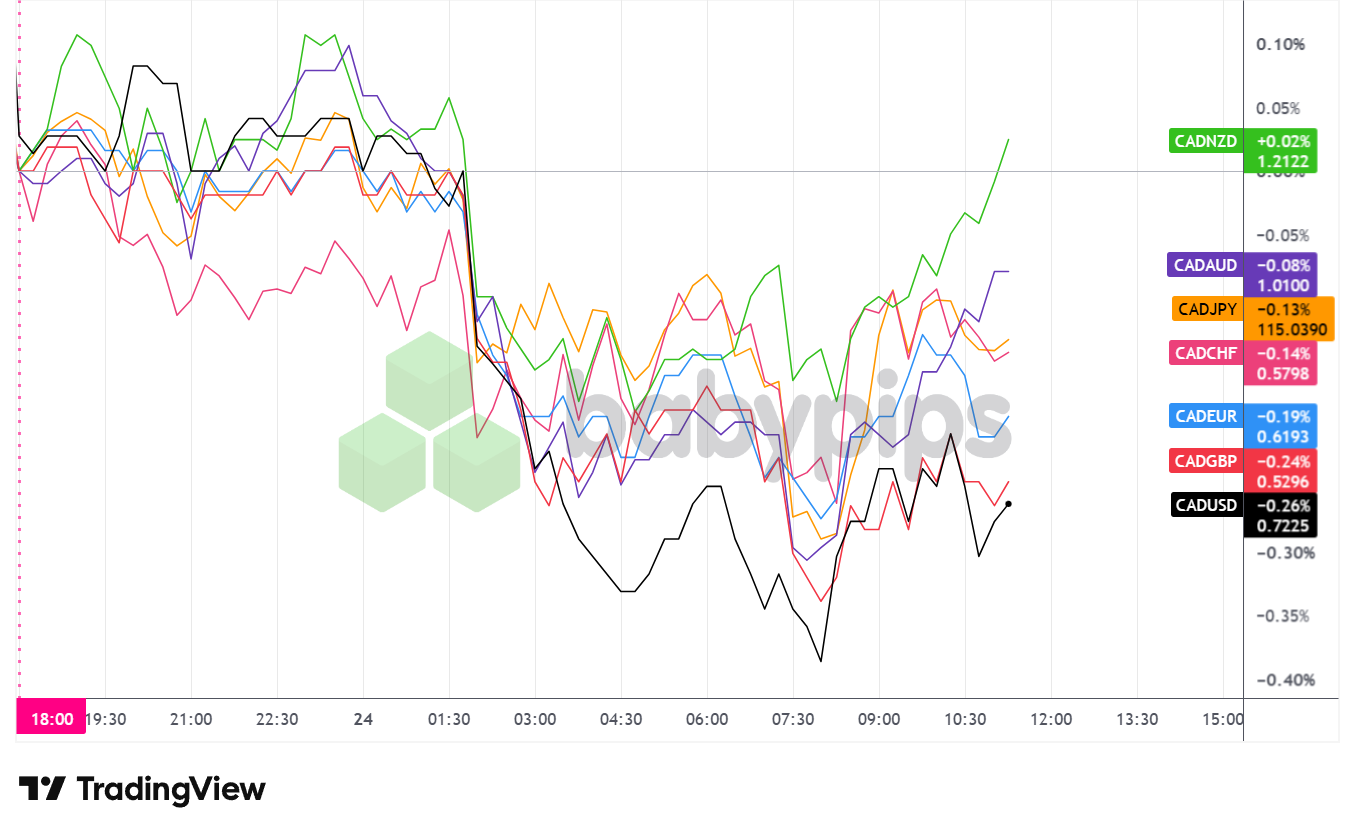
Overlay of CAD vs. Major Currencies – Chart Faster with TradingView
Here’s the interesting part. USD/CAD rose Monday, trading around 1.3830, up roughly 0.5% on the day. The Canadian dollar (the “loonie”) had its worst single day against the US dollar in over two months. Bloomberg pegged the intraday drop at 0.7%, to C$1.3851, worst among G10 currencies. Textbook risk-off: bad trade news, weaker CAD.
But the loonie didn’t just weaken against the dollar. It weakened against everything. A 15-minute overlay of CAD against all seven other major currencies, starting the evening before US tariffs hit, shows a clean, broad-based selloff: CAD fell against the US dollar (-0.26%), the British pound (-0.24%), the euro (-0.19%), the Swiss franc (-0.14%), the Japanese yen (-0.13%), and the Australian dollar (-0.08%), while holding roughly flat against the New Zealand dollar (+0.02%).
That pattern matters. A currency dropping against one counterpart can just be a story about the other currency. A currency dropping against nearly all of them at once is a story about that currency itself. The dollar losses lead the pack because USD sits on the other side of this exact dispute, so it absorbed the most direct hit. But CAD slipped even against currencies with nothing to do with this trade war, like the franc and the yen. That’s the tell: this was Canada-specific stress, not a stronger dollar wearing a CAD costume.
Even so, the size of the move is smaller than a 50% tariff headline suggests it should be. USD/CAD hasn’t spiked toward the 1.40 level some analysts flagged as an “escalation” threshold, and none of the pairs above moved even half a percent except CAD versus the dollar and the pound. Canadian bonds actually rallied. Ten-year yields fell as much as nine basis points, to 3.68%. A weaker currency next to falling yields isn’t what a market bracing for real damage looks like. It looks like traders pricing this as contained, not economy-wide.
Why so calm about a 50% number? Probably a few things at once:
- Scope. The tariffs hit about 5% of Canada’s exports to the US. Painful for specific industries, not a blanket tax on everything Canada sells.
- Oil is untouched, for now. Energy is Canada’s biggest US export, and it’s been left out of this round. Firm oil prices near multi-month highs give the loonie a counterweight, since higher energy prices improve Canada’s “terms of trade” (what it earns from exports relative to what it pays for imports).
- The dollar has its own baggage against USD/CAD specifically. Soft US labor data and bets on earlier Fed rate cuts have capped broad dollar strength, which helps explain why USD/CAD hasn’t run further even as CAD weakens broadly elsewhere.
The lesson: a currency pair rarely tells the whole story on its own. USD/CAD is two economies pulling against each other, and Monday’s move was really the dollar side and the CAD side both playing a role. But the broad overlay chart is the real tell here. When a currency slides against every major at once, that’s the market pricing risk into the currency itself, not just into one bilateral relationship.
You’ve got the macro story on USD/CAD down, but a great thesis still needs a precise entry. Bring this week’s tariff headlines and the loonie’s broad-based selloff to life on TradingView’s Supercharts. Use professional-grade drawing tools and 100,000+ community indicators to map out where USD/CAD, or any of CAD’s cross pairs, might find support as the September 8 retaliation deadline approaches. Don’t just read the headline number, visualize what the market is actually pricing.
The Bottom Line
- The US imposed 50% tariffs on about $20 billion of Canadian goods after talks collapsed August 21-22, 2026. Canada retaliates dollar for dollar starting September 8.
- A tariff rate alone doesn’t tell you the market impact. Scope matters just as much.
- Checking a currency against just one counterpart can mislead you. CAD’s broad-based slide against all seven other majors on Monday confirmed this was Canada-specific stress, not a US dollar story wearing a CAD costume.
- Currency and bond moves don’t always agree. When they diverge, as they did here, ask what each market is actually pricing.
- In trade disputes between unequal partners, the side with less to lose usually gets the better deal.
What to Watch Next
Canada’s retaliatory tariffs hit September 8, targeting US steel, dairy, appliances, agricultural equipment, pulp, paper, and electronics. Watch whether Washington responds or lets it stand. Also on the radar: Fed Chair Kevin Warsh’s first Jackson Hole speech this week, a separate catalyst for the dollar side of USD/CAD.
This article is for educational purposes only. It does not constitute financial advice. Trading involves substantial risk, and past performance is not indicative of future results. Always do your own research and consider consulting with a qualified financial advisor.
The US-Canada trade war shows how policy shocks ripple through currency markets, but most traders only look at one pair. Here’s what traders with deeper market knowledge understand:
Geopolitical Risk, Trade Policy, and Safe Haven Flows Reading this helps you understand how trade policy shocks move currencies beyond the headline number, why checking one pair can mislead you when the real story is a risk-off shift, and which safe havens actually respond when geopolitical friction builds.
And if you’re not a Premium subscriber yet, now’s a good time to join.
With Babypips Premium, you get full access to School of Pipsology lessons that help you understand not just which direction a currency will move in response to a shock, but the analytical mechanism driving it, plus the patterns that repeat across different geopolitical events and timeframes