

Thursday, March 26


USDCHF trades at lowest level since March 2022

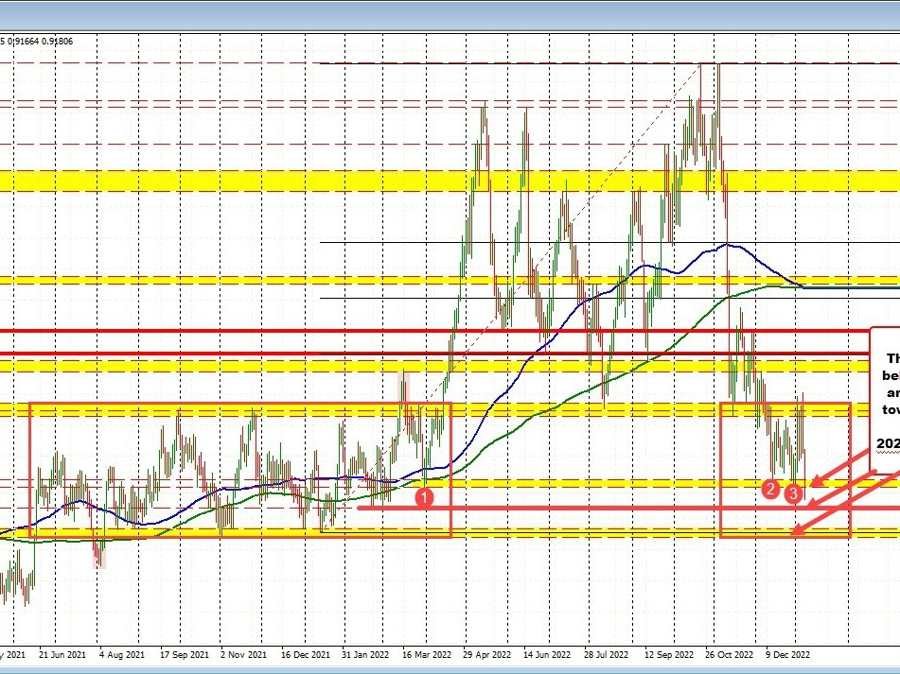
The USDCHF has continued its run to the downside today, and in the process has moved below a swing area on the daily chart between 0.9194 and 0.9211. The pair is trading at the lowest level since March 2022.

Looking at the daily chart above, the next target would be the swing low going back to February 21 and March 1, 2022. Those levels come in at 0.91465. Move below that level, and a swing area between 0.90810 and 0.91014 would be the next target area.

For most of December 2022 and into this month, the price of the USDCHF has reentered into a consolidation area from June 21 until April 22 between 0.9081 on the downside and 0.93822 on the top side (see red box on the chart above).

Yes… there was a instance in July/August 2021 when the price moved below the lower extreme, but failed. There also was a time in in March 2022 when the price moved above the higher extreme of the “red box”, but also failed. However the vast majority of the trading took place within that “red box”.

Last week, the price tried to move above the upper extreme on two separate occasions but each push failed (including Friday before the Goldilocks US jobs report).

The sellers pushed lower on Friday and are continuing the process today.

Close risk now comes in at 0.92115 (a move back above the December 14 low).

Lower yields are helping to push the dollar lower:

  • 2 year 4.193%, -6.3 basis points
  • 5 year 3.641% -6.0 basis points
  • 10 year 3.512% -4.8 basis points
  • 30 year 3.6.6 percent -3.2 basis points

US stocks remain elevated with the NASDAQ
NASDAQ

The Nasdaq Stock Market or NASDAQ is an American stock exchange. It trails only the New York Stock Exchange (NYSE) in market capitalization and is part of a network of stock markets and options exchanges.Launched back in 1971, NASDAQ is the acronym for the National Association of Securities Dealers Automated Quotations. Since then it is known simply as NASDAQ and has become one of the most influential exchanges worldwide.The NASDAQ was the world’s first electronic stock market, and has since assumed the majority of major trades that had been executed by the over-the-counter (OTC) system of trading.What Makes Up the NASDAQ?In particular, the exchange also features the NASDAQ Composite, which includes almost all stocks listed on the NASDAQ stock market. Along with the Dow Jones Industrial Average (DIJA) and S&P 500 Index, this is one of the three most-followed stock market indices in the United States.Overall, the NASDAQ stock market has three different market tiers. This includes the Capital Market, or an equity market for companies that have relatively small levels of market capitalization. The listing requirements for small cap companies are less stringent than for other Nasdaq markets that list larger companies with significantly higher market capitalization.Additionally, the Global Market is made up of stocks that represent the Nasdaq Global Market. The Global Market consists of 1,450 stocks that meet the exchange’s financial and liquidity requirements, and corporate governance standards.Finally, the Global Select Market is a market capitalization-weighted index made up of 1,200 US-based and international stocks that represent the Global Select Market Composite.

The Nasdaq Stock Market or NASDAQ is an American stock exchange. It trails only the New York Stock Exchange (NYSE) in market capitalization and is part of a network of stock markets and options exchanges.Launched back in 1971, NASDAQ is the acronym for the National Association of Securities Dealers Automated Quotations. Since then it is known simply as NASDAQ and has become one of the most influential exchanges worldwide.The NASDAQ was the world’s first electronic stock market, and has since assumed the majority of major trades that had been executed by the over-the-counter (OTC) system of trading.What Makes Up the NASDAQ?In particular, the exchange also features the NASDAQ Composite, which includes almost all stocks listed on the NASDAQ stock market. Along with the Dow Jones Industrial Average (DIJA) and S&P 500 Index, this is one of the three most-followed stock market indices in the United States.Overall, the NASDAQ stock market has three different market tiers. This includes the Capital Market, or an equity market for companies that have relatively small levels of market capitalization. The listing requirements for small cap companies are less stringent than for other Nasdaq markets that list larger companies with significantly higher market capitalization.Additionally, the Global Market is made up of stocks that represent the Nasdaq Global Market. The Global Market consists of 1,450 stocks that meet the exchange’s financial and liquidity requirements, and corporate governance standards.Finally, the Global Select Market is a market capitalization-weighted index made up of 1,200 US-based and international stocks that represent the Global Select Market Composite.
Read this Term
leading the way with a gain of 2.08%. The Dow Industrial Average is up 0.78% in the S&P index is up 1.32%.

The lower dollar has pushed the price of gold
Gold

Gold is the most widely traded and important commodity. Prized for its historical importance and used for trading an exchange of goods, the gold market today is estimated at nearly $2.4 trillion.The value of gold fluctuates constantly, as it trades on public exchanges where it has a price that is determined by supply and demand. Gold has historically had tremendous significance and even today is extremely sought after. Gold has been used as a currency as it doesn’t corrode, and the material allows for some absorption of light creating a yellow glow, which lends the name yellow metal.Ultimately, institutional and retail investors buy and sell gold contracts or physical gold, thus creating the demand and supply flow.This can be pure speculation, to acquire or distribute physical gold, or as a hedge for commercial application. For day-traders, the purpose of trading gold is to profit from its daily price movements.How to Trade GoldDay-trading gold is speculating on its short-term price movements. Of note, physical gold is not actually handled or taken possession of, rather the transactions take place electronically and only profits or losses are reflected in the trading account.There are a number of ways to ultimately trade gold. Retail brokers typically offer exposure to gold through contracts-for-difference (CFDs).Beyond retail brokers, the main way to trade gold is via a futures contract. This represents an agreement to buy or sell something, i.e. gold at a future date. Buying a gold futures contract doesn’t mean you actually have to take possession of the physical commodity.Day traders close out all contracts (trades) each day and make a profit based on the difference between the price they bought the contract and the price they sold it at. However, on a futures exchange, gold moves in $0.10 increments only. This increment is known as a tick. It is the smallest movement a futures contract can make. If you buy or sell a futures contract, how many ticks the price moves away from your entry price determines your profit or loss.

Gold is the most widely traded and important commodity. Prized for its historical importance and used for trading an exchange of goods, the gold market today is estimated at nearly $2.4 trillion.The value of gold fluctuates constantly, as it trades on public exchanges where it has a price that is determined by supply and demand. Gold has historically had tremendous significance and even today is extremely sought after. Gold has been used as a currency as it doesn’t corrode, and the material allows for some absorption of light creating a yellow glow, which lends the name yellow metal.Ultimately, institutional and retail investors buy and sell gold contracts or physical gold, thus creating the demand and supply flow.This can be pure speculation, to acquire or distribute physical gold, or as a hedge for commercial application. For day-traders, the purpose of trading gold is to profit from its daily price movements.How to Trade GoldDay-trading gold is speculating on its short-term price movements. Of note, physical gold is not actually handled or taken possession of, rather the transactions take place electronically and only profits or losses are reflected in the trading account.There are a number of ways to ultimately trade gold. Retail brokers typically offer exposure to gold through contracts-for-difference (CFDs).Beyond retail brokers, the main way to trade gold is via a futures contract. This represents an agreement to buy or sell something, i.e. gold at a future date. Buying a gold futures contract doesn’t mean you actually have to take possession of the physical commodity.Day traders close out all contracts (trades) each day and make a profit based on the difference between the price they bought the contract and the price they sold it at. However, on a futures exchange, gold moves in $0.10 increments only. This increment is known as a tick. It is the smallest movement a futures contract can make. If you buy or sell a futures contract, how many ticks the price moves away from your entry price determines your profit or loss.
Read this Term
higher. The current price of gold is up $11.15 or 0.60% at $1876.50.

The price of crude oil is also higher help by China reopening hopes and stronger growth as a result. The price of crude oil is currently up $1.35 on the day at $75.14. Although higher it is in the middle of the day’s trading range between $73.55 and $76.69.


Source link

Share.
FX

Leave A Reply