


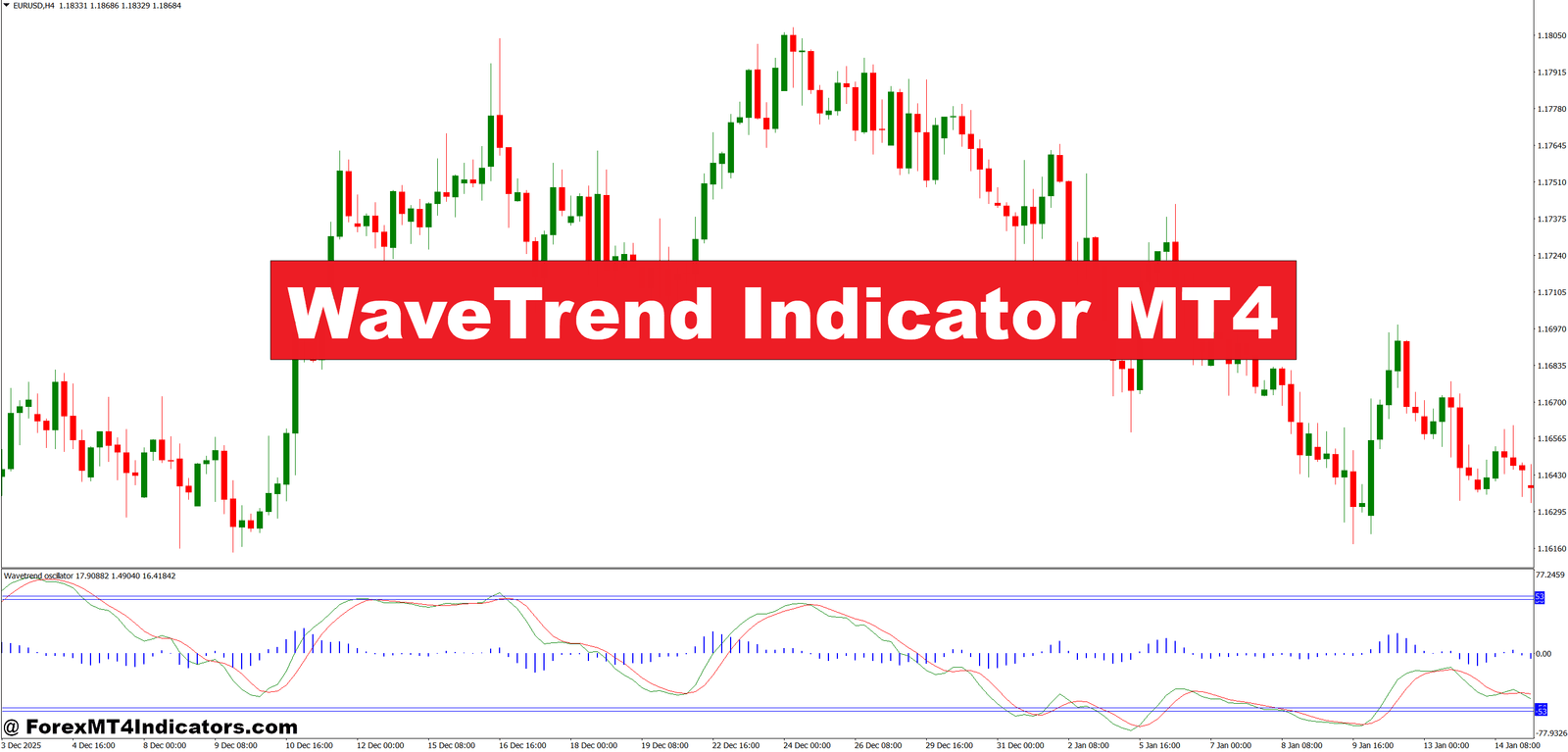
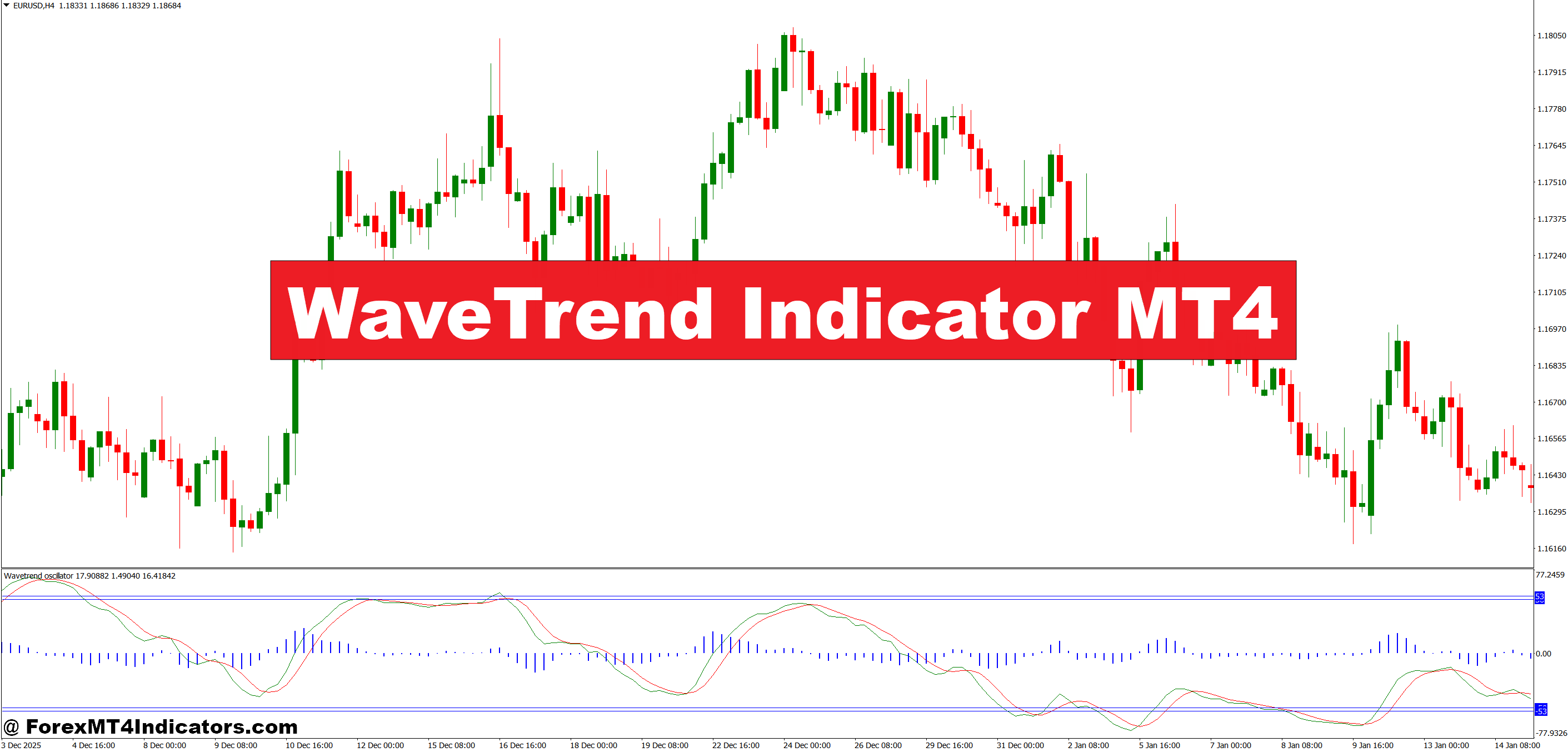
The WaveTrend Indicator MT4 addresses this challenge by measuring momentum waves and identifying overbought or oversold extremes before they become obvious to everyone else. Unlike standard oscillators that lag or generate excessive false signals during choppy markets, WaveTrend smooths price data through a dual-averaging process that helps traders spot genuine momentum shifts rather than market noise.
What the WaveTrend Indicator Actually Measures
WaveTrend is a momentum oscillator that tracks the relationship between current price and average price over a specified period. Think of it as measuring how far price has stretched from its equilibrium point. The indicator oscillates around a zero line, moving into positive territory when buying pressure dominates and dipping negative when sellers control the action.
What sets this tool apart is its dual-line structure. The main line (often called WT1) responds quickly to price changes, while a signal line (WT2) acts as a moving average of the first line. When these lines cross, they signal potential momentum shifts—similar to MACD crossovers but with different smoothing mathematics behind them.
The indicator also displays overbought and oversold zones, typically marked at +60 and -60 levels. When the WaveTrend line pushes into these extreme zones, it suggests price has moved too far too fast and a correction may be near.
The Calculation Behind the Momentum

WaveTrend uses a multi-step smoothing process that reduces whipsaw signals common in raw momentum indicators. First, it calculates the typical price (high + low + close divided by three), then applies an exponential moving average to this value. The difference between current typical price and this smoothed average gets divided by the mean absolute deviation—a statistical measure of volatility.
This normalized value then receives another round of exponential smoothing to create the main WaveTrend line. The signal line is simply a moving average of this smoothed value. The math might sound complex, but the practical result is an oscillator that responds to real momentum shifts while filtering out the random price jiggles that plague shorter-period RSI or Stochastic readings.
Traders don’t need to calculate this manually—MT4 handles the heavy lifting. But understanding the logic helps explain why WaveTrend behaves differently during trending versus ranging markets.
Real-World Trading Applications
During the Asian session on GBP/JPY, a trader noticed the WaveTrend lines had crossed bullish near the -60 oversold level on the 15-minute chart. Price was forming a higher low while the indicator showed a higher low as well—a bullish divergence pattern. The trader entered long at 183.45, placed a stop below the recent swing low at 183.15, and rode the move to 184.20 for a 75-pip gain.
This type of setup—waiting for oversold/overbought extremes combined with line crossovers—forms the core strategy for many WaveTrend users. The key is confirmation. A crossover alone doesn’t mean much if it happens near the zero line during sideways chop. But when crosses occur at extremes, especially with divergence present, the probability of a genuine reversal increases.
Some traders use WaveTrend for trend confirmation rather than reversals. On higher timeframes like the daily chart, staying long while the indicator remains in positive territory can help ride extended trends. When WT1 crosses below WT2 and both lines start declining, that’s a signal the trend may be losing steam.
One common mistake is treating every extreme reading as an immediate reversal signal. During strong trends, WaveTrend can stay overbought or oversold for extended periods. The GBP/USD rally in late 2024 saw the daily WaveTrend remain above +60 for two straight weeks. Traders who shorted the first overbought reading got crushed.
WaveTrend Indicator MT4 Customizing Settings

The standard WaveTrend settings use a 10-period channel length and a 21-period average length, with a 4-period signal line. These defaults work reasonably well on 1-hour to 4-hour charts for major pairs like EUR/USD or USD/JPY. But scalpers and swing traders need different sensitivity levels.
For quick scalping on 5-minute charts, reducing the channel length to 6 or 7 periods makes the indicator more responsive to short-term moves. The trade-off is more false signals, so this approach demands tighter risk management. Testing this on AUD/USD during the Sydney open showed improved entry timing but also more breakeven stops.
Swing traders working off daily charts often increase the channel length to 14 or 15 periods and bump the average length to 28. This configuration filters out minor corrections and focuses on major momentum shifts. A test run on USD/CAD daily charts over six months showed fewer signals but a higher win rate on the trades that triggered.
Currency pairs with different volatility profiles also need adjustment. The EUR/CHF tends to move sluggishly compared to GBP/JPY. Using more sensitive settings on a low-volatility pair helps generate tradable signals, while extremely volatile pairs benefit from more conservative parameters to avoid getting chopped up.
Strengths and Honest Limitations

WaveTrend excels at identifying momentum exhaustion before it becomes obvious on the price chart. The dual-smoothing process reduces false signals compared to raw RSI or Stochastic readings, especially during choppy conditions. The indicator also produces clear divergence signals that can catch major turning points.
That said, no indicator works in isolation. WaveTrend can generate excellent signals in trending or clearly defined ranging markets, but it struggles during transitional phases when the market character is shifting. A trader who relied solely on WaveTrend during the consolidation period in EUR/USD from December 2024 to January 2025 likely experienced frustration as the indicator whipsawed around the zero line.
The extreme zones aren’t magic levels. Just because price reaches overbought doesn’t mean it won’t go higher. Strong news events or central bank interventions can push momentum to sustained extremes that contradict oscillator readings. This is why experienced traders combine WaveTrend with price action analysis—support and resistance levels, candlestick patterns, or market structure breaks.
Compared to MACD, WaveTrend provides clearer overbought/oversold levels but can be slightly laggier on crossover signals. Against RSI, it offers better smoothing but loses the simplicity of a single-line reading. Some traders run both WaveTrend and a simple 200-period moving average, only taking WaveTrend signals that align with the broader trend direction.
How to Trade with WaveTrend Indicator MT4
Buy Entry

- Bullish crossover at oversold extreme – Enter long when WT1 crosses above WT2 while both lines are below -60 level on EUR/USD 1-hour chart; place stop 20-30 pips below recent swing low.
- Bullish divergence confirmation – Take buy signal when price makes lower low but WaveTrend makes higher low, then wait for crossover; works best on GBP/USD 4-hour timeframe during trending markets.
- Zero line bounce entry – Go long when WaveTrend pulls back to zero line and bounces higher during established uptrends on daily charts; skip this signal during sideways consolidation.
- Double dip pattern – Enter buy when indicator drops to oversold twice without breaking market structure below; second touch at -60 often signals strong reversal with 50-80 pip potential.
- Risk 1-2% per setup – Never risk more than 2% account equity on WaveTrend signals; use 30-50 pip stops on 1-hour setups, wider 80-100 pips on 4-hour charts.
- Avoid during major news – Skip buy signals 30 minutes before and after NFP, FOMC, or central bank announcements; momentum oscillators fail during high-impact volatility spikes.
- Confirm with price action – Only take long entries when crossover occurs near support zones or after bullish engulfing candles; standalone oscillator signals have 45-55% win rate.
- Exit at opposite extreme – Close 50% position when WaveTrend reaches +60 overbought zone; trail remaining position with 40-pip stop until full exit signal appears.
Sell Entry

- Bearish crossover at overbought extreme – Enter short when WT1 crosses below WT2 while both lines are above +60 level; works consistently on USD/JPY 1-hour during Asian session.
- Bearish divergence setup – Sell when price makes higher high but WaveTrend makes lower high, then wait for downward crossover; best results on GBP/USD 4-hour with 60-pip targets.
- Rejection from zero line – Go short when WaveTrend rallies to zero from below during downtrends and gets rejected; ignore this signal if daily chart shows strong uptrend.
- Extended overbought failure – Enter sell when indicator stays above +60 for 3+ candles then crosses bearish; often catches 100+ pip reversals on EUR/USD 4-hour charts.
- Position size conservatively – Use 1.5% risk on counter-trend shorts since they fail more often; increase to 2% only when daily timeframe confirms downtrend alignment.
- Skip in strong uptrends – Don’t short overbought readings when price is above 200 EMA on 4-hour chart; wait for trend confirmation break before taking sell signals.
- Layer with resistance zones – Only execute shorts when WaveTrend crossover aligns with previous swing high or psychological round numbers like 1.1000 on EUR/USD.
- Manage winners aggressively – Move stop to breakeven after 30-pip gain on shorts; momentum can reverse quickly, so lock profits at -40 or -50 indicator levels.
Making It Work in Your Trading
The WaveTrend Indicator MT4 gives traders a sophisticated way to measure momentum that goes beyond basic oscillators. Its strength lies in catching exhaustion points where most traders are still chasing the move. The dual-line crossover system combined with extreme zones creates a framework for identifying high-probability setups.
But here’s the thing—success comes from understanding context. WaveTrend signals mean more when they align with broader market structure, key support or resistance, or fundamental catalysts. Traders who treat it as a standalone system often discover that filters and confirmation make the difference between a useful tool and a source of frustration.
Trading forex carries substantial risk, and no indicator guarantees profits. The WaveTrend won’t prevent losses during unpredictable news events or sudden volatility spikes. What it can do is provide an edge when used as part of a complete trading plan that includes solid risk management and realistic expectations.
Start by testing WaveTrend on a demo account with different timeframes and settings. Track which configurations match your trading style and the pairs you follow. The real value emerges not from following every signal mechanically, but from recognizing the patterns where the indicator consistently aligns with actual market behavior.
Recommended MT4/MT5 Broker
XM Broker
- Free $50 To Start Trading Instantly! (Withdraw-able Profit)
- Deposit Bonus up to $5,000
- Unlimited Loyalty Program
- Award Winning Forex Broker
- Additional Exclusive Bonuses Throughout The Year
- Exclusive 90% VIP Cash Rebates for all Trades!


Already an XM client but missing out on cashback? Open New Real Account and Enter this Partner Code: VIP90
(Free MT4 Indicators Download)