




If you were hoping for a quiet start to the trading week, you might want to brew an extra pot of coffee.
On Friday, March 20, President Trump posted that the U.S. was “getting very close” to winding down military operations in Iran. Oil eased, and markets exhaled.
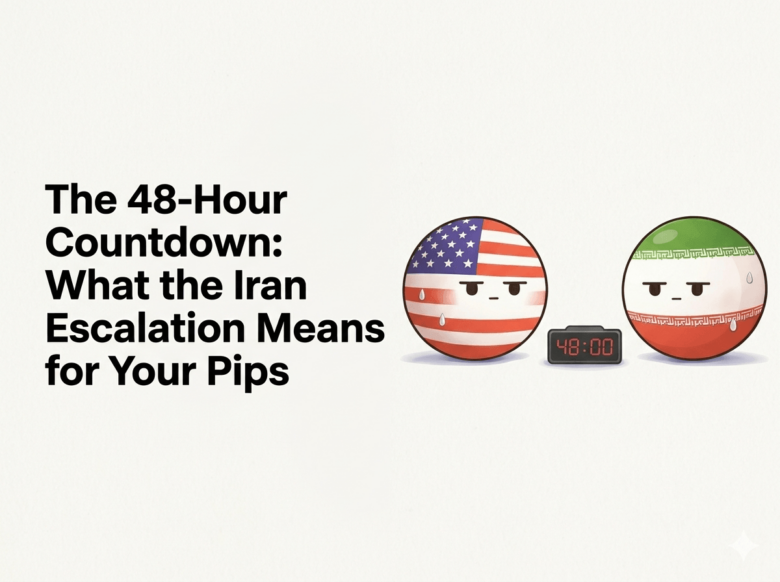
Then, less than 24 hours later, Trump flipped the script entirely — threatening to “obliterate” Iranian power plants unless the Strait of Hormuz is fully reopened within 48 hours. The global markets are currently staring down a ticking clock that’s set to expire Monday night around 7:44 PM ET.
Iran’s parliament responded immediately, calling regional energy infrastructure “legitimate targets” for retaliation.
For traders, this represents a live event risk that can gap your charts and blow straight through your stops.
Let’s break down exactly how this tension filters through the markets and what it means for your account.
What a Geopolitical Risk Premium Means for Traders
Here’s the first thing to understand: prices move before a single shot is fired.
Imagine you need five cases of charcoal for a weekend BBQ at roughly $10 each. Then, news breaks that a storm is about to destroy the only charcoal factory in the country. Shelves are still full, and the sun’s still shining, but the price jumps to $25 immediately.
You’re not paying more because charcoal got better. You’re paying a fear markup a.k.a. the cost of uncertainty about tomorrow’s supply.
Financial markets work the same way. The moment Trump’s ultimatum hit the news wires, oil and gold traders started pricing in the probability of disruption.
This markup can vanish just as fast as it builds, which is why a de-escalation can trigger a violent sell-off in oil even when the actual news is “good.”
To understand what’s driving that fear this week, let’s review what we know about one key waterway.
The Currency Shuffle: How Hormuz Hits Your Pairs
When the conflict kicked off on February 28, Iran’s most dangerous move didn’t involve a single missile. Instead, it was more like a chokehold on the global economy’s jugular: the Strait of Hormuz.
Traffic cratered. Tankers were damaged, and ships were stranded. Brent crude hit $126 per barrel at its peak. U.S. gas prices climbed to $3.94 a gallon, up more than a dollar in a single month. The IEA called it the largest oil supply disruption in the history of the global market.
Here’s how that translates to your charts:
Strait closes → oil spikes → everything costs more to produce and ship → inflation jumps → central banks get paralyzed → currencies reprice.
Promoted: Stop Risking Your Own Capital on Unpredictable Trade Policies.
You’ve seen how geopolitical updates spike volatility, but playing big macro shifts requires serious capital. With FundingPips, you trade a simulated account and can earn up to 100% of your rewards. Whether you’re looking for a 2 Step PRO evaluation starting at just $26 or seeking funding options up to $300K, you have the flexibility to trade your way.
Learn more about FundingPips and use code HELLO to get 20% OFF your first purchase!
Disclosure: We may earn a commission from our partners if you sign up through our links, at no extra cost to you.
The Fed is already holding rates at 3.5–3.75%, and its dot plot now signals just one cut in 2026 — down from two — because surging oil has made easing politically toxic. The ECB held and raised its inflation forecast for the same reason.
When central banks can’t cut despite slowing growth, you get stagflation — high inflation and weak growth at the same time.
For forex traders, this kind of shock pulls flows into familiar patterns:
- Safe havens (USD, JPY, CHF) get bought. The USD Index jumped more than 0.5% the day strikes began. The Swiss franc surged so hard the SNB warned it might intervene.
- Oil exporters (CAD, NOK) get a split. Canada is a net energy exporter, so higher oil prices fatten its trade balance — the Loonie has been among the strongest majors this month. But recession fears and a surging dollar cap the gains.
- Energy importers (EUR, AUD) get hit hardest. Europe sources 12–14% of its LNG from Qatar through the Strait; the euro has surrendered most of its early-2026 gains. Japan gets roughly 70% of its Middle Eastern oil via Hormuz, so ballooning import bills crush its terms of trade.
Two Paths: Peace or Power Plants?
As we approach Monday night’s deadline, markets are essentially playing a high-stakes game of “Choose Your Own Adventure.”
Path A: The De-escalation Pivot
If Iran signals compliance or a diplomatic channel opens, expect a sharp risk relief rally but don’t let it fool you. Oil could sell off hard precisely because the fear markup disappears, even though the news is technically “good.”
Safe-haven bids in USD and CHF would unwind quickly, gold would pull back from its volatile $5,050–$5,418 range, and stocks would breathe again. The speed of that reversal could be just as violent as the original spike.
Path B: The “Lights Out” Strike
If Trump strikes those power plants and Iran retaliates against Gulf energy infrastructure (Saudi pipelines, Qatari LNG terminals, UAE oil facilities) the supply shock deepens fast, and the damage would be hard to contain. The dollar would likely surge as investors dump every risky asset they can find, but that’s cold comfort when the broader economic outlook is deteriorating.
What makes both paths trickier to trade is the White House’s contradictory signaling. On the same Friday, Trump said “winding down,” deployed thousands more marines, and lifted sanctions on Iranian oil — all within hours of each other. Israel’s defense minister contradicted him the same day, saying strikes would “significantly increase.”
When the policy signal itself is the noise, positioning before the deadline starts to look a lot like gambling.
Protecting Your Pips: The Only Lesson That Matters This Week
With deadlines ticking and “obliteration” in the headlines, caution matters more than any indicator right now.
Events like this are unpriceable. No algorithm or chart pattern can accurately predict what a world leader will do five minutes before a deadline. These events tend to send asset volatility all over the charts, and the smartest move is often to lower your position size or stay on the sidelines entirely until the dust settles.
Remember, the goal of a trader isn’t just to make money; it’s to stay in the game. If you bet the farm on a “peace” rally and the power plants get hit, your trading career could be over in a single candle.
Keep your eyes on the 7:44 PM ET deadline on Monday. Whether we see a de-escalation or a new phase of conflict, the market will react violently. Stay nimble, watch your leverage, and don’t let the headlines trade for you.
Promoted: Master Your Execution During Macro Shocks
When geopolitical news causes volatility spikes, does your execution stay clinical or get emotional? TradeZella’s trade replay tool lets you revisit your past trades tick-by-tick. See exactly where your entry slipped or why you hesitated, so you can dominate the next volatility spike with a data-driven playbook.
Start Your Journal with Tradezella and use code “PIPS20” to save 20% on your first purchase!
Disclosure: To help support our free daily content, we may earn a commission from our partners if you sign up through our links, at no extra cost to you.


